2018
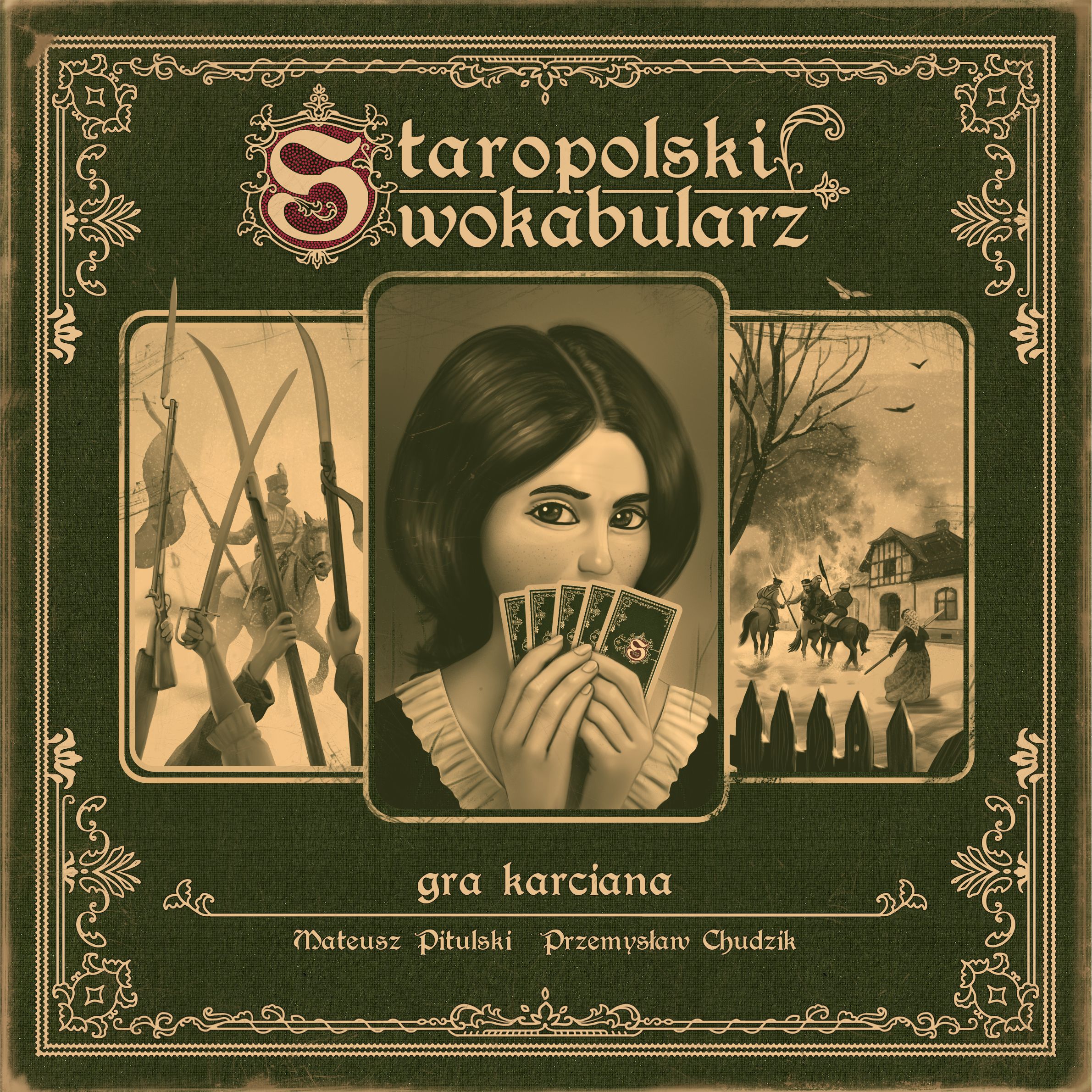
Staropolski wokabularz
2–2 jugadores · 20 min · 8+
„It’s 1893 AD. It has been almost thirty years since the fall of the January Insurrection, and the repressions of the invaders still continue. But the spirit of freedom still lasts in Poles… Young conspirators are plotting against the oppressants by all possible means – the stake is the survival of culture, art and Polish language. In Old-Polish Glossary you take the role of plotters who want to remember about the Old-Polish language. Create sets of words and perform tasks in this marvelously – illustrated lexical memory game.”
Staropolski wokabularz ("Old-Polish Glossary") is a game for two people with about twenty minutes playing time. Players alternate taking turns. On their turn a player is manipulating his cards in order to gather a set of four cards of the same category one after another. Categories stem from various areas of medieval life (i.e. medicine, science, handicraft, cookery) which are represented on cards by Old – Polish words coming from medieval manuscripts. The game can be also won by realizing two out of four available task cards (in every game 4 out of 6 available task cards are being used). A player’s turn is based on action points. A player can spend them in five possible ways:
 Take another card to their stand
 Exchange cards within their stand
 Exchange cards between stands
 Reject a card from their stand
 Peek at any card in the deck
What is interesting about Staropolski wokabularz is that players put most cards on special stands back to a player and what makes it easier to remember them are… colourful clips, which can be used to mark cards!
—description from the designer
Reglas y estrategia
Las fuentes de esta edición aún necesitan preparación o revisión.
Preparar conocimiento de reglas
Necesitamos las reglas originales para responder con fiabilidad.
Inicia sesión para enviar un reglamentoPregunta sobre Staropolski wokabularz
Las respuestas muestran sus fuentes. Te avisaremos si la evidencia falta o no es clara.