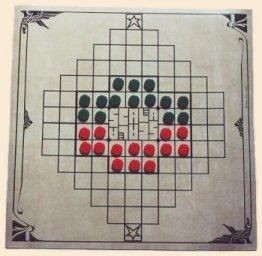
1986
Scala
2–2 players · 0 min
Object: to advance a stone into the opposite goal.
Blue (stones marked 'O') moves first with a goal square of f14. Red (stones marked 'X') moves second with a goal square of f1. Turns alternate.
A stone may either move to any adjacent (orthogonal or diagonal) empty space or may make a jump or a series of jumps. A jump is over any stone (friend or foe, orthogonal or diagonal) landing on the opposite empty space. A player may make multiple jumps on the same turn, may change direction after each jump, and may mix jumping enemy and friendly stones but may not move or jump into the goal the player is defending. If after a move is completed the set of ALL stones consists of two or more disconnected groups then some stones will be eliminated as follows: 1 - First the monochrome groups will be eliminated; 2 - If this leaves no stones on the board, then the moving player loses; 3 - From the remaining (mixed) groups, all groups apart from the biggest group will be eliminated; 4 - If that leaves two or more biggest groups of same size the moving player loses.
Rules and strategy
Source knowledge for this edition still needs preparation or review.
Prepare rules knowledge
Source rules are needed before we can answer reliably.
Sign in to submit a rulebookAsk about Scala
Answers show their sources. When the evidence is missing or unclear, we’ll say so.